No products in the cart.

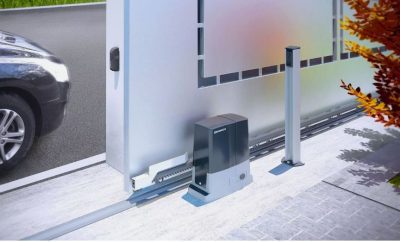
An automatic gate not working in Oman in July is usually not a broken gate. In most of the calls we attend between May and September, the motor has shut itself down deliberately. It reaches a temperature limit, stops, cools, and runs again by evening. Knowing the difference between that and a real fault saves an unnecessary call out. It also saves working motors from being replaced.
Almost every gate motor sold in Oman has a thermal cutout inside it. It is a temperature sensitive switch sitting in or against the motor windings. When the windings pass a set temperature, the switch opens and power to the motor stops. When they cool, the switch closes and the motor runs again. Nobody resets it. It resets itself.
From outside, a thermal shutdown looks exactly like a dead motor. The remote does nothing. The wall button does nothing. The gate will not move. Most residential units give no light, no beep and no error code. There is nothing to tell the two apart by looking.
The only reliable clue is time of day. A gate that is dead at three in the afternoon and alive at nine at night has not failed. It reached its thermal protection and recovered. A gate that is equally dead at six in the morning has a real fault. That is the coolest the housing gets all day.
That test costs nothing. It is the most useful thing an owner in Oman can do before phoning. It is also why we ask what time the gate stopped before anything else.
Reaching the cutout once in a summer is normal. Reaching it every afternoon is a message. Either the mechanical load has risen, or the motor is being asked for more cycles than it was built to give. The first is far more common, and it is fixable without replacing anything.
Heat and sand are not two separate problems in Oman. They are one loop, and every turn of the loop makes the next turn worse. Almost nobody explains this part. It is why a gate that was fine for three years suddenly is not.
An automatic gate not working in Oman in August is usually the far end of this loop. Read from the top, it is a housekeeping problem. Read from the bottom, it is a dead control board. They are the same problem at different ages.
There is a detail in the specifications that matters in Oman and matters almost nowhere else. Gate operators and photocells are commonly rated for ambient temperatures up to around 55 degrees Celsius. That number is a shade air figure.
A motor housing bolted next to a dark steel gate on an open driveway is not sitting in shade air. It is absorbing direct sun for six hours, and it is radiating heat back from the gate leaf beside it. In direct sunshine the effective heat load can run roughly 8 degrees above the shade figure.
Muscat has a mean daily maximum near 40.4 degrees in June, and the highest temperature on record is 49.2 degrees. Against a 55 degree rating that looks like comfortable headroom. On a driveway in Al Khuwair at two in the afternoon there is no headroom at all. The same arithmetic applies in Sohar, Nizwa, Sur and Duqm. In Salalah the humidity works against cooling instead of the temperature.

| What you see | What is actually happening | Is it a fault | What to do |
|---|---|---|---|
| Gate stops in the afternoon, works again after sunset | Thermal cutout reached. The motor stopped to save itself | No | Clear the track, avoid repeated cycles at peak heat, book a service |
| Gate still works but moves slower than it did last year | Rolling resistance has risen. Sand in the track, dry or worn rollers, rack teeth packed | Not yet, but it is heading there | Clean the track and rack now, before the summer, not during it |
| Gate opens but will not close, only at one time of day | Low sun is sitting in the photocell beam line and confusing the receiver | No, it is an alignment problem | Shade or reangle the photocells, or fit cells with a sun filter |
| Gate opens but will not close at any time of day | Photocell beam genuinely broken. Dust film on the lens, a knocked bracket, or something parked in the path | Yes, but usually a small one | Wipe both lenses with a dry cloth, check nothing sits in the beam |
| Motor hums but the gate does not move | Drive is disengaged, or the motor is stalled against a physical jam | Yes | Stop immediately. Do not retry. A stalled motor heats very fast |
| Burning smell, or the unit is dead even at dawn | Heat damage to the windings or the control board, built up over seasons | Yes | Switch it off at the isolator and call. Do not keep trying it |
Most cases of an automatic gate not working in Oman begin with something on this list. Do this early in the morning, while the metal is cool enough to touch. All of it is free and none of it needs a tool. It resolves a fair share of the calls we get.
One thing to leave alone. Do not grease the track. It is the most natural instinct and in Oman it is the wrong one. Grease holds blown sand against the running surface. That becomes a grinding paste, and it wears rollers and raises resistance permanently. A dry film lubricant, silicone or graphite, is the correct choice here because it does not hold grit. Rollers, hinges and pivot points are a different matter and a light dry spray on those is fine.

Everything below carries either mains voltage or a safety function. Getting any of it wrong can turn a working gate into a hazard.
The important one is the second. When a gate starts stopping in the heat, raising the force setting makes the symptom disappear for a few weeks. It also makes the motor pull harder, which makes it hotter, which brings the next shutdown forward. It treats the alarm by disconnecting the alarm.
Manufacturer schedules are written in Italy and Germany. They assume rain that washes the track, dust that settles and stays there, and a summer peaking in the low thirties. None of that describes this country. A single shamal puts airborne sand back into a track swept last week. The interval here is driven by sand events, not by the calendar.
| Task | Typical European manual | What we recommend in Oman | Why the difference |
|---|---|---|---|
| Sweep track and clear rack | As required | Weekly, and again after any shamal | Blown sand returns within days, not months |
| Full clean and inspection of track, rack and rollers | Once a year | Every four months | Sand abrasion here is continuous, not seasonal |
| Photocell lens clean and alignment check | Once a year | Every four months | Dust film cuts beam strength before it blocks it |
| Motor service, force check, fixings and mounting | Once a year | Twice a year, one of them before May | The service that matters is the one done before the heat, not after a failure |
| Control board and enclosure check, seals and vents | Once a year | Twice a year | Repeated heat cycling ages board components faster |
| Battery pack on 24 V systems | Every two to three years | Check yearly from year two | Sustained heat shortens battery service life |
| Lubrication | Per manual, often grease | Dry film only, never grease on the track | Grease plus blown sand becomes an abrasive paste |
If you take one line from that table, take the row about May. A gate serviced in April behaves through the summer. The same gate serviced in September gets a repair bill instead of a service bill.
Thermal shutdown explains a large share of summer complaints, but not all of them. Treat the following as genuine faults and stop using the gate until somebody has looked at it.
The last one is worth taking seriously even though the gate still works. It usually means the slowdown or the encoder feedback has stopped working. A heavy leaf arriving at full speed damages the rack, the end stop and then the gearbox.
Because it reached its thermal cutout. The motor windings passed a set temperature, an internal switch opened, and power was removed to prevent damage. Once the windings cool, the switch closes and the gate works normally again. Nothing is broken at that moment. It is a warning that the load or the duty on the motor has risen.
Not on the day it happens. The cutout exists precisely to prevent damage. The problem is cumulative. Repeated heat cycling over two or three summers ages the winding insulation and the control board. Board failure, when it comes, is permanent. So a gate that cuts out every afternoon should be serviced, not ignored.
Almost always the photocells, not the motor. A gate that refuses to close while still opening normally has working drive and a blocked or confused safety beam. Wipe both lenses and check nothing sits in the path. Then look at whether it only happens at one time of day. If it does, low sun is in the beam line and the cells need reangling or shading.
Twice a year, with one of those visits before May. Manufacturer schedules of once a year are written for European dust and European summers. In Oman the track needs sweeping weekly and a full clean every four months. The pre summer visit is the one that decides whether you get through July without a call out.
No. Grease holds blown sand against the running surface and becomes an abrasive paste. That wears rollers and increases the load on the motor. Use a dry film lubricant such as silicone or graphite, which lubricates without holding grit. Keep it off the track surface itself and put it on rollers, hinges and pivots.
Not on its own, and it is rarely the first thing to change. In most cases the load has risen through sand in the track, dry rollers or a misaligned rack. Clearing that returns the gate to normal running. Fitting a different motor onto an unresolved mechanical problem simply moves the failure further down the line. Establish why the load rose first.
Doors Auto is at Shop No 176, Way Street No 57, Block No 17/2, Al Khuwair, Muscat. We hold gate motors, control boards, photocells, remotes and spare parts in Oman. Our own engineers carry out the work. We are open 09:00 to 21:00, seven days a week.
Call or message on WhatsApp on +968 78109286, or email contact@doorsauto.com. If your gate stops in the heat, tell us what time it happens. Tell us whether it recovers in the evening. That one detail usually tells us what we are coming to before we arrive.