
No products in the cart.
33%
RFID Card Reader in Oman | Wiegand Output for Access Control Panels
Official Dealer
Authorized in Oman
Fast Delivery
Across all of Oman
1 Year Warranty
On installation
200 in stock
200 in stock
Add to Wishlist
Add to Wishlist
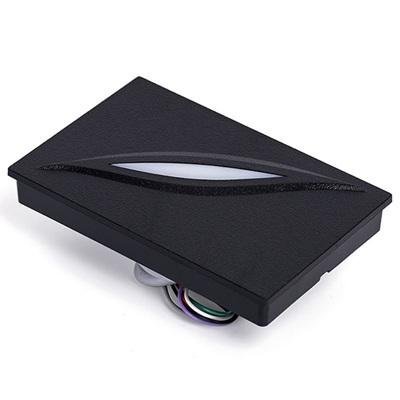
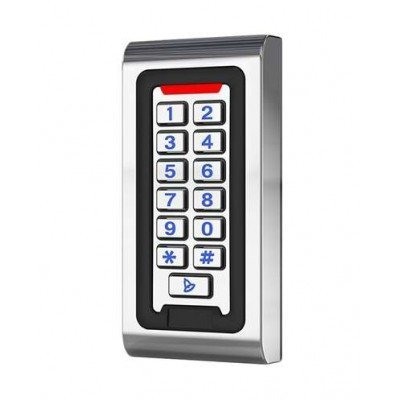
A 125 KHz RFID card reader with Wiegand output, for use with an access control panel. It reads the card and passes the number to your controller, which decides whether the door opens — so it does nothing on its own. Two readers on one controller give you card in and card out. Stocked in Al Khuwair, Muscat.
Description
What this RFID card reader does, and what it does not
This is a 125 KHz RFID card reader with a Wiegand output. A card is presented, the reader converts the card number into a Wiegand data stream, and sends it down four wires to a controller. The controller holds the user list, makes the decision and switches the lock. The reader holds nothing and switches nothing.
That distinction is the single most common reason an access control order goes wrong in Oman. If you have no controller, this reader will not open your door no matter how it is wired. You want a standalone keypad reader instead, and we stock those too.
Wiegand or RS485 — check before you order anywhere
RFID readers at this price point come with two completely different outputs, and the listings rarely make it clear. Wiegand is four wires (12 V, ground, Data 0, Data 1) and is what almost every access control panel in the Omani market expects. RS485 and RS232 are serial outputs used by attendance terminals, parking systems and some networked platforms.
They are not interchangeable. An RS485 reader will not talk to a Wiegand panel, and no adaptor in the box will fix it. We have seen readers sold in Oman under a “Wiegand” heading whose own specification sheet lists only RS232, TTL and RS485 — so read the interface line, not the title. This reader is Wiegand. If your controller needs RS485, tell us and we will supply the right one rather than sell you this.
Matching the reader to your cards
Frequency has to agree at both ends. This unit reads 125 KHz EM cards — the standard EM4100 and EM4102 credentials, which is what most Omani offices and compounds already hold. It will not read 13.56 MHz Mifare, HID, Paradox or other encrypted formats.
If you already have a stack of cards and do not know which they are, bring one to the shop or send us a photo of both faces. We will check it against the reader before you pay. We stock matching 125 KHz cards if you need to start fresh.
Wiegand bit format
The reader outputs Wiegand 26 or 34 bit. Wiegand 26 is the default on nearly every controller sold here and is what we ship it set to. If your panel is configured for 34 bit, say so when ordering and we will confirm the reader matches before it leaves the shop. A format mismatch shows up as the controller ignoring valid cards, which is a frustrating fault to chase after the cable is already in the wall.
Two readers on one door
Most controllers accept two readers, one each side of the door. That gives you card in and card out instead of a card in and a push button out.
Card out is worth the second reader wherever you need a record of who left, not just who arrived — staff doors, server rooms, stores. An exit button records nothing at all. It is cheaper, and correct where you only need egress.
Wiring and cable runs
Use screened multicore back to the controller and keep it clear of mains cable. Wiegand is unbalanced low-voltage signalling and it picks up interference from anything running alongside it. Bond the screen at the controller end only.
Distance is the usual failure. Wiegand degrades over long runs, and beyond roughly 100 m you are into intermittent faults that look like a faulty reader but are not. Tell us the run length and we will specify the cable, or tell you when the door needs a different approach.
Where it is used
Office entrances, apartment lobbies, warehouse personnel doors, clinic staff areas and compound gatehouses across Muscat. Anywhere the controller should stay inside on a protected wall and only the reader faces the weather.
It also suits a system that will grow. Adding a fourth and fifth door needs a reader each, not a panel each — which is why a panel-plus-reader system costs less per door than five standalone units as soon as you pass three doors.
Buying it in Oman
We hold this reader in stock at our shop in Al Khuwair, Muscat, and deliver Oman-wide including Sohar, Salalah, Nizwa, Sur and Duqm. Our own engineers install it, so if the format does not match your panel or the cable run is too long, that is our problem to solve rather than yours to discover. See the rest of our access control range in Oman.
Common questions
Does this RFID card reader work on its own?
No. It reads the card and sends the number to a controller, which makes the decision and switches the lock. Without a panel behind it, nothing opens. If you want one device that does the whole job on a single door, ask us for a standalone keypad reader instead.
How do I know whether my controller needs Wiegand or RS485?
Look at the terminal block on the panel. Wiegand panels have terminals marked D0 and D1. RS485 panels have terminals marked A and B, or 485+ and 485−. If you can photograph the terminal strip and send it to us, we will tell you which reader you need before you buy anything.
Will it read the cards I already have?
If they are 125 KHz EM cards, yes. If they are Mifare, HID or another encrypted format, no. Send us a photo of both faces of one card and we will check it against the reader.
What is the difference between Wiegand 26 and 34 bit?
How many bits of card number the reader sends. The reader and the panel have to agree. A mismatch looks like the controller ignoring valid cards. Twenty-six bit is the default here and what we ship it set to.
How far can the reader be from the controller?
Wiegand degrades over distance and the practical ceiling is around 100 metres on screened cable, less if it runs near mains. Tell us your cable run and we will confirm it before you order.
Can I have a reader on both sides of the door?
Yes, on any controller with two reader inputs. That gives you a card-out record instead of a push button, which records nothing.
Do you install access control in Muscat?
Yes. Our own engineers fit and commission it, including setting the Wiegand format and enrolling your cards.
RFID Card Reader Specifications
- Product Type: RFID proximity card reader, Wiegand output
- Card Frequency: 125 KHz
- Card Types: EM4100 / EM4102 and compatible. Does not read 13.56 MHz Mifare, HID or Paradox
- Output: Wiegand 26 bit (34 bit available — specify when ordering)
- Read Distance: [CONFIRM — typically 3–15 cm]
- Read Speed: [CONFIRM — typically under 0.3 s]
- Operating Voltage: [CONFIRM — typically DC 9–16 V]
- Current Draw: [CONFIRM — typically 25–70 mA]
- Ingress Protection: [CONFIRM from the unit — do not publish "waterproof" without a number]
- Indicators: [CONFIRM — LED and buzzer]
- Maximum Cable Run: [CONFIRM against your controller — typically 100 m]
- Dimensions: [MEASURE IT]
- Works Standalone: No. A separate access control panel is required
- Readers Per Door: Two on most controllers, giving card in and card out
- Supplied From: Stock, Al Khuwair, Muscat
Additional information
| Output | Wiegand |
|---|---|
| Works standalone | No |

Reviews
There are no reviews yet.